Get the Educational Guide to Real-Estate-Backed Private Lending
REAL-ESTATE-BACKED PRIVATE CREDIT PLAYBOOK
The Institutional Private Credit Education guide helps with Understand the Property, Capital Stack, Downside & Exit Before Evaluating Potential Return. So you can make an educated decision based on accurate information.
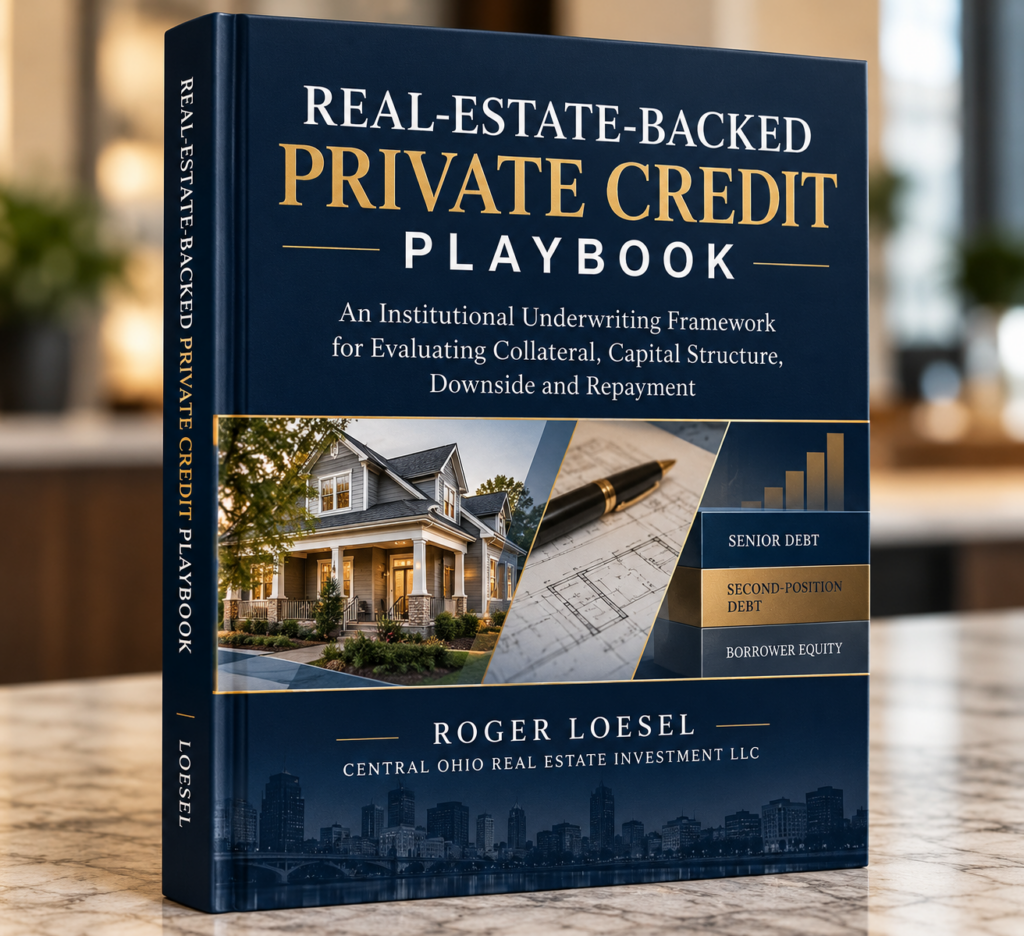
Before You Evaluate the Return, Understand Where Your Capital Sits
Get the Educational Guide to Real-Estate-Backed Private Lending
A private real estate loan may be secured by property.
But that alone does not tell you enough about the risk.
Before evaluating a potential return, it can be useful to understand:
- What debt sits ahead of the lender
- Where a second-position loan sits in the capital stack
- How senior and junior debt combine
- Why combined LTV matters
- What an equity cushion does—and does not—tell you
- What supports the loan
- What is actually expected to repay the loan
- What could happen if the property’s value is lower than projected
- What happens when a rehabilitation project does not go according to plan
- Why the exit strategy deserves attention before the potential return
A Better Framework for Evaluating Private Real Estate Credit
The educational framework I use starts here:
Property → True Project Basis → Valuation → Capital Stack → Leverage → Borrower → Execution Risk → Downside → Exit → Potential Return
The order is intentional.
A high projected return cannot repair weak underwriting.
Get the Educational Guide
The Accredited Investor’s Guide to Real-Estate-Backed Private Lending
This educational resource is being developed to help readers better understand the questions that can matter when evaluating real-estate-backed private credit.
REAL-ESTATE-BACKED PRIVATE CREDIT PLAYBOOK
The Institutional Private Credit Education guide helps with Understand the Property, Capital Stack, Downside & Exit Before Evaluating Potential Return. So you can make an educated decision based on accurate information.
SEND ME THE EDUCATIONAL GUIDE
No investment is being offered on this page. This resource is for educational purposes.
What You’ll Learn
1. How a Real Estate Capital Stack Works
Learn the basic relationship among:
Property Value
↓
Senior Debt
↓
↓
Borrower / Operator Equity
Understanding where capital sits can be just as important as understanding how much interest a loan may pay.
2. Why Second Position Matters
A second-position lender generally sits behind senior debt.
That means the junior loan should not be evaluated by itself.
The senior debt, total leverage, collateral, borrower equity, project execution and exit strategy all deserve consideration.
3. Why Combined LTV Can Tell a Different Story
A $25,000 junior loan against a property expected to be worth $200,000 may initially appear small.
But if $100,000 of senior debt already exists, total debt is:
$125,000
Using the simplified $200,000 value:
$125,000 ÷ $200,000 = 62.5% Combined LTV
Looking only at the junior loan would miss an important part of the structure.
4. Why Projected Value Deserves Scrutiny
An after-repair value is an estimate of what a property may be worth after work is completed.
It is not the same thing as today’s property value.
And it is not a guarantee of what a future buyer will pay.
The guide helps explain why current value, projected value, project basis and downside scenarios should be considered separately.
5. What Happens When the Original Plan Doesn’t Work?
What happens if:
- Rehabilitation costs increase?
- Construction takes longer?
- Property value comes in lower?
- The property does not sell on schedule?
- Refinancing is unavailable?
- Senior debt increases?
- The borrower defaults?
Good underwriting should consider these questions before they become problems.
Two Questions I Believe Every Private Lender Should Understand
What Supports the Loan?
Real estate collateral may support the credit.
But then there is another question:
What Is Expected to Repay the Loan?
The expected repayment source might be:
- A property sale
- Refinancing
- Operating cash flow
- Another documented source
Those are not necessarily the same thing.
Collateral supports the loan.
The repayment strategy explains where the money is expected to come from to pay it back.
Understanding the difference is fundamental to disciplined credit analysis.
Education Before Return
I believe private real estate credit should be approached in this order:
Understand the property.
Understand the collateral.
Understand the borrower.
Understand the use of proceeds.
Understand the capital stack.
Understand the downside.
Understand the exit.
Then evaluate the potential return.
Get the Educational Guide
The Accredited Investor’s Guide to Real-Estate-Backed Private Lending
Learn the framework and questions that can help you better understand real-estate-backed private credit before evaluating potential return.
REAL-ESTATE-BACKED PRIVATE CREDIT PLAYBOOK
The Institutional Private Credit Education guide helps with Understand the Property, Capital Stack, Downside & Exit Before Evaluating Potential Return. So you can make an educated decision based on accurate information.
SEND ME THE EDUCATIONAL GUIDE
About Roger Loesel
Roger Loesel is an Ohio licensed real estate professional and experienced real estate investor/operator who teaches practical approaches to evaluating real estate, project basis, capital structure, leverage, downside and exit strategy.
His educational work is designed to help people ask better questions and make better-informed decisions.
Roger teaches. CORI operates.
Central Ohio Real Estate Investment LLC provides the operating context behind Roger’s real-world educational work in value-add residential real estate.
Educational Disclaimer
This page and related materials are provided for general educational and informational purposes only.
They are not an offer to sell securities, a solicitation to purchase an investment, individualized investment advice, legal advice or tax advice.
Private lending and real estate investments involve risk, including possible loss of principal. A mortgage, lien position, appraisal, projected value, equity cushion or other real estate collateral does not guarantee repayment or eliminate investment risk.
Actual lien priority, lender rights, collateral value and repayment outcomes depend on the applicable facts, documents and law.
Readers should conduct independent due diligence and consult appropriate legal, tax, financial and other professional advisers before making financial or investment decisions.