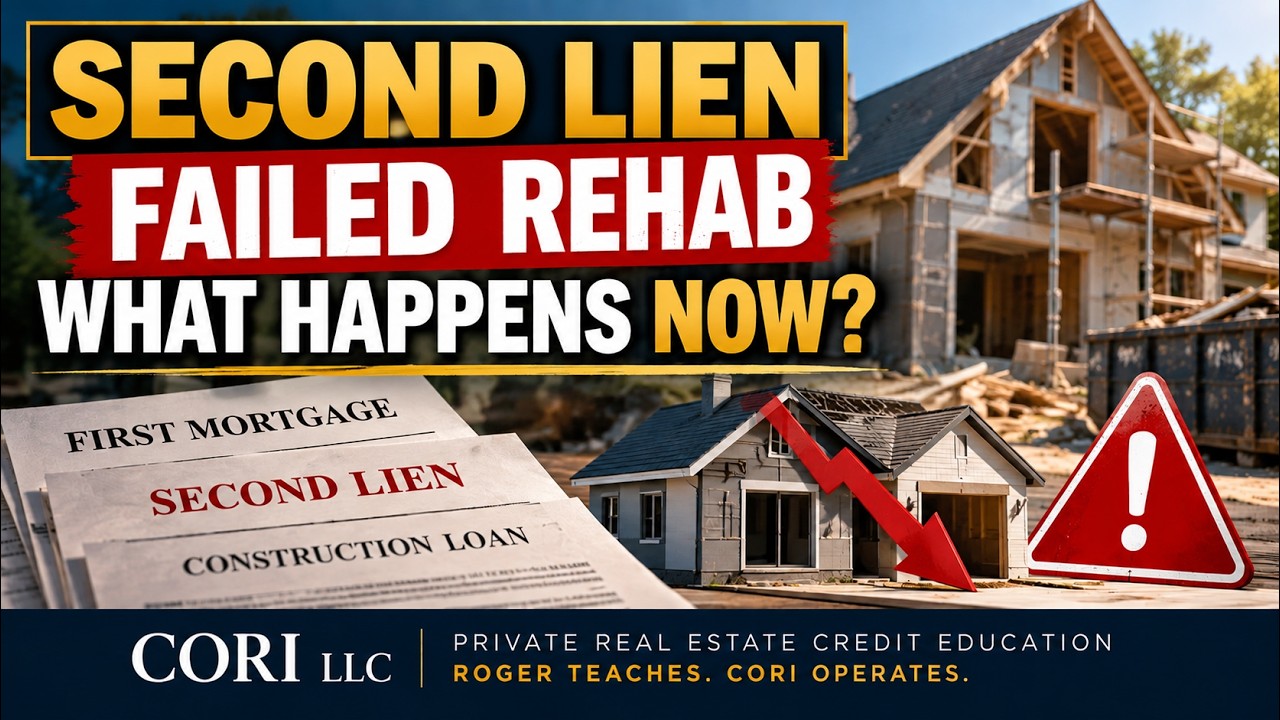
Second Lien Rehab Project Failure: What Happens to the Lender?
When a Rehab Project Fails, a Second Lien May Survive.
That Doesn’t Mean the Money Is Protected.
A second lien rehab project failure can change the economics of a real-estate-backed loan quickly.
Property value may decline. Construction may remain unfinished. Senior obligations can matter more. Additional capital may be required. And the original sale or refinance strategy may no longer work.
Get the free 2026 Real-Estate-Backed Private Credit Master Playbook and learn a property-first framework for evaluating collateral, capital structure, leverage, rehab risk, downside, repayment and recovery.
Get the Free 2026 Master Playbook
SEND ME THE FREE PLAYBOOK
REAL-ESTATE-BACKED PRIVATE CREDIT PLAYBOOK
The Institutional Private Credit Education guide helps with Understand the Property, Capital Stack, Downside & Exit Before Evaluating Potential Return. So you can make an educated decision based on accurate information.
Before You Ask About Return, Understand What Happens When the Project Doesn’t Go as Planned
A second-position mortgage tells you something important:
where a lender sits in the capital structure.
It does not, by itself, tell you whether the lender will be repaid.
That distinction becomes especially important when a rehabilitation project fails.
The original underwriting may have assumed that construction would be completed, the property would reach a projected value, and a sale or refinance would generate enough liquidity to repay the debt.
But what happens when those assumptions don’t occur?
The analysis changes.
Instead of asking only:
What was the projected ARV?
A disciplined lender should start asking:
What is the property worth in its current condition—and what has to happen from here for principal to be repaid?
What Can Change During a Second Lien Rehab Project Failure?
A troubled rehabilitation project can affect several risks simultaneously.
Property Value
An unfinished property may be worth materially less than the projected completed value.
Senior Debt
A second-position lender must understand the obligations with priority ahead of the junior position—not simply look at the junior loan balance.
Cost to Complete
The original remaining construction budget may no longer represent the actual amount required to finish and stabilize the property.
Operator Liquidity
Someone may need to contribute additional capital.
The question becomes:
Who has that capital—and will they actually contribute it?
Repayment
The original sale or refinance may no longer work.
Recovery
Even when a lien remains legally valid, the amount ultimately recoverable can depend on collateral value, priority, additional costs, time, documents and the specific circumstances.
The Critical Difference
A Lien Can Survive While the Economic Cushion Disappears.
This is one of the most important concepts in second-position private real-estate credit.
Lien existence is not the same as lien priority.
Lien priority is not the same as collateral coverage.
Collateral coverage is not the same as repayment.
And a projected ARV is not cash available to repay principal today.
That is why CORI’s educational framework analyzes the entire credit structure.
A Simple Rehab-Failure Example
Consider an illustrative rehabilitation project:
Current unfinished property value: $178,000
Senior secured amount: $113,000
Second-position credit: $45,000
That produces:
Combined debt: $158,000
and only:
$20,000 of apparent value above combined debt.
Now introduce another fact:
Estimated capital required to complete the project: $42,000.
The original question may have been:
“How much equity is in the property?”
The better questions now become:
Who supplies the additional $42,000?
Will additional senior debt increase the amount ahead of the second lien?
Is the current unfinished value supportable?
Would spending another $42,000 actually create sufficient additional market value?
What happens if nobody supplies the money?
What is the realistic recovery scenario?
That is the difference between looking at a loan balance and underwriting the entire project.
The CORI Failure-Case Framework
When a rehabilitation project materially departs from the original plan, the framework moves through the transaction in this order:
1. CURRENT PROPERTY VALUE
What is the unfinished property reasonably worth today?
2. SENIOR OBLIGATIONS
What debt and other secured amounts actually sit ahead of the second position?
3. SECOND-POSITION EXPOSURE
What is the junior lender’s actual economic exposure?
4. OTHER CLAIMS AND COSTS
What taxes, assessments, construction-related claims, preservation costs, legal expenses or other obligations could affect recovery?
5. COST TO COMPLETE
How much capital is required today to finish or stabilize the property?
6. AVAILABLE LIQUIDITY
Who has the financial capacity and willingness to supply that money?
7. DOWNSIDE
What happens if value declines further, construction costs increase or completion takes longer?
8. REPAYMENT
What event is realistically expected to create the cash needed to repay principal?
9. RECOVERY
What may remain if the expected repayment strategy doesn’t occur?
Only Then:
Evaluate the Potential Return.
Go Beyond This One Scenario
Get the 2026 Real-Estate-Backed Private Credit Master Playbook
The second-lien rehab failure scenario is only one part of real-estate-backed credit analysis.
The 2026 Master Playbook teaches the larger underwriting system:
PROPERTY → BASIS → VALUE → CAPITAL STACK → LEVERAGE → BORROWER → EXECUTION → DOWNSIDE → REPAYMENT → EXIT → RETURN
Inside the Playbook, readers learn about:
Property & Collateral Analysis
Understand the real estate underlying the credit.
True Project Basis
Move beyond purchase price to understand the actual economic commitment.
Valuation Architecture
Distinguish current value, completed value and downside/recovery value.
Capital Structure
Understand senior debt, junior debt and operator equity.
First- and Second-Position Lending
Understand what lien position means—and what it doesn’t.
Combined Leverage
See why one loan balance can hide the actual debt burden.
Borrower & Operator Analysis
Evaluate the person or organization responsible for executing the business plan.
Rehabilitation Risk
Analyze budgets, cost to complete, contingency, draws and construction controls.
Stress Testing
Evaluate lower value, higher costs, delays and combinations of adverse events.
Repayment & Exit
Understand what is expected to produce the liquidity necessary to repay principal.
Recovery Analysis
Examine what may happen when the base case doesn’t occur.
Credit Committee Decision-Making
Bring the analysis together into a disciplined credit decision.
Download the Complete Master Playbook
Learn the Framework Before Evaluating the Return.
Whether you’re a financial professional, experienced investor, business owner or someone beginning to study private real-estate credit, the purpose of this Playbook is the same:
Help you ask better questions before capital is at risk.
GET YOUR FREE COPY
REAL-ESTATE-BACKED PRIVATE CREDIT PLAYBOOK
The Institutional Private Credit Education guide helps with Understand the Property, Capital Stack, Downside & Exit Before Evaluating Potential Return. So you can make an educated decision based on accurate information.
GET THE 2026 MASTER PLAYBOOK
Free educational resource. No investment opportunity is being offered.
Who Is This Educational Playbook For?
The Master Playbook was developed for readers who want to understand real-estate-backed private credit beyond interest rates and advertised returns.
That includes financial professionals, experienced real-estate investors, sophisticated investors, business owners, accredited investors and everyday investors learning how real-estate-backed private credit works.
A reader does not need to be an accredited investor simply to access CORI’s educational material.
The objective here is education—not qualification for a particular offering.
About Roger Loesel
Real Estate Operator Perspective. Credit-First Education.
Roger Loesel is an Ohio-licensed real estate professional and experienced real-estate investor/operator.
His private-credit educational work approaches underwriting from the perspective of someone who understands the underlying property, rehabilitation process and execution risk—not simply the loan’s stated interest rate.
The central question is:
What would I need to understand about the property, capital structure, downside and repayment before placing capital at risk?
Roger teaches. CORI operates.
Central Ohio Real Estate Investment LLC
Read the Full Topic #2 Analysis
Want to go deeper into this specific scenario before downloading the Playbook?
Read: What Happens to a Second Lien if a Rehab Project Fails?
A Second Lien Tells You Where the Debt Sits.
The Underwriting Tells You What That Position May Actually Mean.
Before focusing on the potential return, learn how to examine:
the property • the basis • the capital stack • the leverage • the operator • the rehab • the downside • the repayment • the exit
GET THE FREE 2026 REAL-ESTATE-BACKED PRIVATE CREDIT MASTER PLAYBOOK
REAL-ESTATE-BACKED PRIVATE CREDIT PLAYBOOK
The Institutional Private Credit Education guide helps with Understand the Property, Capital Stack, Downside & Exit Before Evaluating Potential Return. So you can make an educated decision based on accurate information.
SEND ME THE PLAYBOOK
Educational & Risk Disclosure
This website and the 2026 Real-Estate-Backed Private Credit Master Playbook are provided solely for general educational and informational purposes. They are not an offering memorandum, private placement memorandum, term sheet, offer to sell, solicitation to purchase, or recommendation concerning any security or transaction, and they are not individualized investment, legal, accounting, tax or financial advice.
Private credit, private placements and real-estate investments involve material risks, including possible loss of principal and illiquidity. A mortgage, lien position, appraisal, projected value, after-repair value, borrower equity or apparent collateral cushion does not guarantee repayment or prevent loss.
Actual lien priority, creditor rights, remedies, collateral value and recovery depend upon transaction-specific facts, documentation and applicable law. Any actual transaction should be evaluated independently using applicable transaction documents and appropriate professional advisers.
© 2026 Central Ohio Real Estate Investment LLC
Private Real Estate Credit Education