
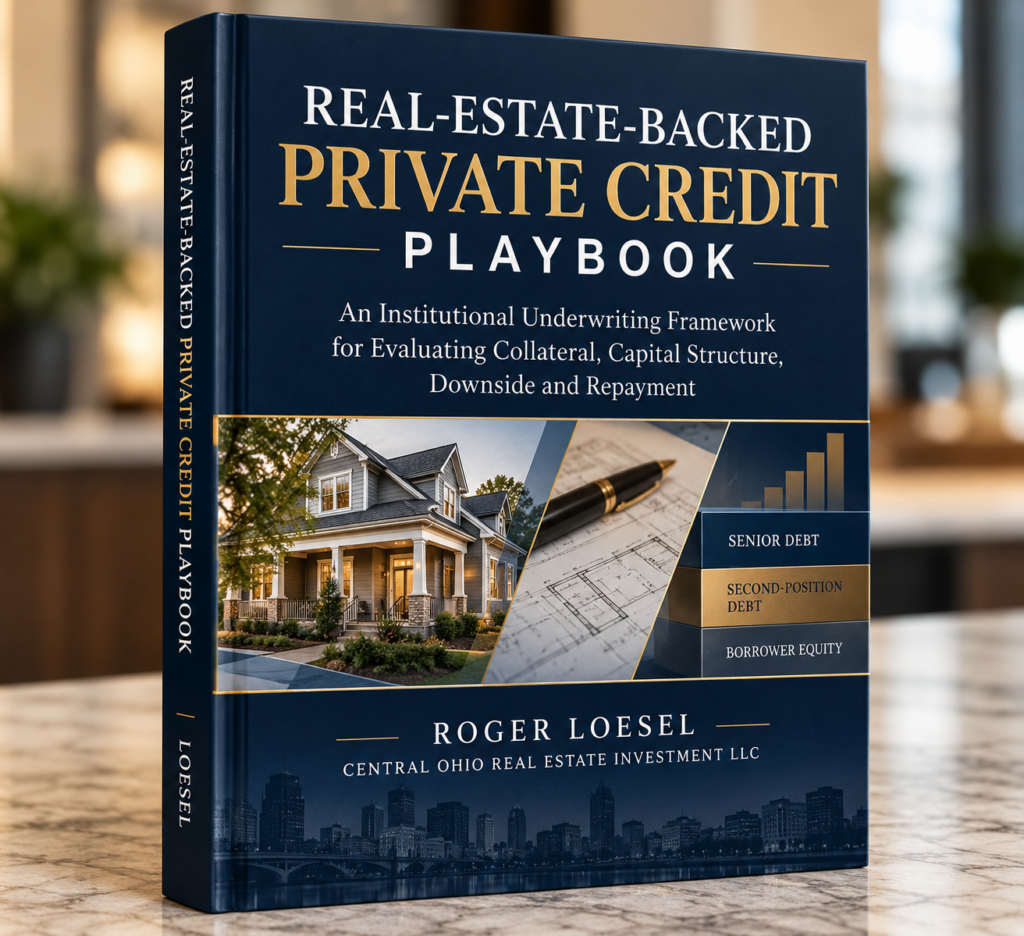
What Should You Understand Before Evaluating Real-Estate-Backed Private Credit?
For the full break down – click here
How to Evaluate Real-Estate-Backed Private Credit
When people first encounter a private real estate credit opportunity, one number can quickly attract attention:
The potential return. When it should be ” How to Evaluate Real-Estate-Backed Private Credit opportunity ” .
Interest rates or projected return tells you very little about the real estate, debt structure and assumptions responsible for producing that return.
Before asking, “What could this pay?” there may be a much more important series of questions:
What property is behind the credit?
What debt already sits ahead of the lender?
How much total leverage does the property have to support?
What assumptions have to work for the borrower to repay the loan?
And perhaps most importantly:
What happens if the original plan does not work as expected?
Those questions are the reason I created The REAL-ESTATE-BACKED PRIVATE CREDIT PLAYBOOK.
It is an educational resource designed to help readers look beyond the headline numbers and better understand the underwriting questions that may exist behind real-estate-backed private credit.
A Mortgage Is Only the Beginning of the Analysis
The statement “the loan is backed by real estate” may sound reassuring.
But it does not answer enough questions by itself.
Consider what you still would not know.
You wouldn’t necessarily know the property’s current value.
You wouldn’t know how that value was determined.
You wouldn’t know how much senior debt already exists.
You wouldn’t know whether the private credit sits in first or second position.
You wouldn’t know the project’s true total cost.
You wouldn’t know how much capital the operator has at risk.
You wouldn’t know what happens if construction takes longer or costs more than expected.
And you wouldn’t know what is actually expected to generate the cash necessary to repay the debt.
That is why I believe real-estate-backed private credit should be evaluated as credit, not simply as a return attached to a piece of property.
Collateral is the beginning of the analysis—not the conclusion.
The Capital Stack Matters
One of the most important concepts in private real estate credit is also one of the easiest to overlook:
Where does your capital actually sit?
A property can have multiple layers of capital associated with it.
There may be senior acquisition or rehabilitation debt.
There may be second-position or other subordinate debt.
There may be operator equity.
There may also be additional project costs and obligations that deserve consideration.
Looking only at one loan without understanding the rest of the capital structure can create an incomplete picture.
For example, a relatively small second-position loan may appear conservative when compared with the property’s projected completed value.
But that comparison alone doesn’t tell you how much debt sits ahead of that lender.
It doesn’t tell you the property’s combined leverage.
And it doesn’t tell you what happens to the apparent equity cushion if the property ultimately sells for less than projected.
This is why understanding the real estate capital stack should come before evaluating the potential return.
Want to understand this concept more deeply?
Read our educational pillar resource:
Where Does a Second-Position Lender Actually Sit in a Real Estate Capital Stack?
That lesson explains the relationship among senior debt, junior debt, combined loan-to-value, equity and downside risk in plain English.
Projected Value Is Not the Same as Today’s Value
Real estate underwriting can involve several different ideas of value.
A property may have a value today.
It may have a projected value after renovations are completed.
And it may have a very different value if the property must be sold under unfavorable conditions.
Those numbers should not automatically be treated as interchangeable.
That distinction becomes especially important with value-add real estate.
If a credit decision depends heavily on what a property is expected to be worth after construction, then the assumptions behind that future value deserve scrutiny.
What work still needs to be completed?
How much should that work cost?
How long should it take?
What comparable properties support the projected value?
What happens if the finished property is worth less than originally expected?
The deeper question is not simply:
“What is the projected value?”
It is:
“What assumptions must become true for that value to exist?”
Rehabilitation Risk Can Become Credit Risk
I have spent 17 years working with real estate from the operator side.
That experience has taught me something important:
A spreadsheet does not renovate a property.
Neither does an appraisal.
Real projects involve contractors, materials, inspections, permits, schedules, unforeseen conditions, carrying costs and human execution.
A project expected to cost one amount can cost more.
A rehabilitation expected to take four months can take eight.
An unexpected structural, mechanical or permitting issue can change the economics of the project.
That matters to a lender because additional time and additional cost can affect:
Project basis.
Borrower liquidity.
Interest carry.
Equity cushion.
Refinancing.
Sale timing.
And ultimately repayment.
That is why one of the principles behind the Playbook is:
In transitional real estate, execution risk can become credit risk.
Collateral and Repayment Are Not the Same Question
This distinction deserves special attention.
Ask two separate questions:
What supports the credit?
That may include the underlying real estate, recorded security documents and other transaction-specific protections.
What is expected to repay the credit?
That may be a property sale.
It may be a refinance.
It may be operating cash flow.
It may involve another documented source of liquidity.
These are related questions, but they are not identical.
A property can provide collateral while the original repayment strategy still fails.
That is why a disciplined review should consider both the source of repayment and the potential recovery path.
What Happens When the Original Assumptions Are Wrong?
Good underwriting shouldn’t examine only the scenario where everything works.
It should ask what happens when something doesn’t.
What if the property value is lower?
What if construction costs more?
What if completion takes longer?
What if refinancing becomes more difficult?
What if the property has to be sold instead?
What if additional expenses appear during a recovery?
The purpose of asking those questions isn’t to predict every possible outcome.
It is to understand how dependent the credit is on favorable assumptions.
That is the difference between simply looking at a projected return and beginning to understand the risk responsible for producing that return.
Introducing The REAL-ESTATE-BACKED PRIVATE CREDIT PLAYBOOK
To organize these questions into a more disciplined framework, I created:
THE REAL-ESTATE-BACKED PRIVATE CREDIT PLAYBOOK
An Institutional Underwriting Field Guide for Evaluating Collateral, Capital Structure, Downside & Repayment
The Playbook was developed for readers who want to better understand how experienced real estate operators and sophisticated capital providers can think about the credit behind a real estate transaction.
Rather than beginning with potential return, the framework begins with the underlying economics.
The sequence is intentional:
Asset → True Project Basis → Valuation → Capital Structure → Leverage → Borrower → Execution → Downside → Repayment & Exit → Potential Return
The Playbook explores the questions within each of those areas without pretending that any single metric can determine whether a transaction is appropriate.
It also includes a structured Credit Committee Checklist designed to help readers organize their own due-diligence questions.
I deliberately created the Playbook to do something different from a promotional investment brochure.
It is designed to help you ask better questions.
Why I Put Return Near the End
Potential return matters.
But I believe it makes more sense after you understand what must happen to produce it.
A high projected return cannot change the property’s physical condition.
It cannot reduce senior debt.
It cannot complete construction.
It cannot guarantee an appraisal.
It cannot create a refinance.
And it cannot guarantee repayment.
That is why my educational framework follows a simple philosophy:
Understand the property.
Understand the downside.
Know the exit.
Then evaluate the potential return.
That philosophy is the foundation of The REAL-ESTATE-BACKED PRIVATE CREDIT PLAYBOOK.
Start With the Capital Stack
If second-position real estate credit is unfamiliar—or if you want to understand how senior debt, junior debt and operator equity interact—start with our in-depth educational pillar page:
Where Does a Second-Position Lender Actually Sit in a Real Estate Capital Stack?
Read the Capital Stack Guide →
From there, you can examine lien position, combined leverage, equity cushion, downside considerations and the relationship between collateral and repayment in greater depth.
Get The REAL-ESTATE-BACKED PRIVATE CREDIT PLAYBOOK
If you want to take the next step, access the complete educational resource:
THE REAL-ESTATE-BACKED PRIVATE CREDIT PLAYBOOK
The Playbook provides the structured framework behind the concepts introduced in this article and gives you a more disciplined way to organize the questions you may want to ask before evaluating potential return.
GET THE EDUCATIONAL PLAYBOOK →
The goal isn’t to tell you what investment decision to make.
The goal is to help you become a better-informed evaluator of the property, capital structure, assumptions, downside and repayment strategy behind real-estate-backed private credit.
About Roger Loesel
Roger Loesel is an Ohio licensed real estate professional and experienced real estate investor/operator who teaches private real estate credit from the perspective of the underlying property and operating business.
His educational approach begins with a practical question:
What would I need to understand about this property, borrower and capital structure before placing capital at risk?
That operator perspective forms the foundation of the Private Real Estate Credit Education Series.
Roger teaches. CORI LLC – Central Ohio Real Estate Investment LLC operates.
Educational Disclosure
This article and The REAL-ESTATE-BACKED PRIVATE CREDIT PLAYBOOK are provided solely for general educational and informational purposes.
They are not an offering memorandum, private placement memorandum, term sheet, offer to sell, solicitation to purchase, recommendation concerning any security or transaction, or individualized investment, legal, accounting, tax or financial advice.
Private credit, private placements and real estate investments involve risk, including possible loss of principal and illiquidity. Real estate collateral, lien position, appraisals, projected values, borrower equity or an apparent collateral cushion do not guarantee repayment or eliminate investment risk.
Any actual transaction should be independently evaluated based on its specific facts, documentation and applicable law with appropriate professional advisers.